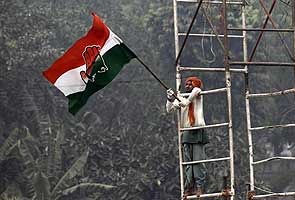
New Delhi: For
two decades, Lalu Prasad was a giant on India's political stage. He ran
a state of 100 million people, he took charge of the country's massive
rail network and his party was a crucial prop for the shaky coalition
government in New Delhi.
Lalu managed all this despite a constant
whiff of corruption around him. Indeed, he liked to thumb his nose at
the law, riding triumphantly on the back of an elephant after a brief
spell behind bars in 1997 as a crowd of admirers cheered.
Last week, a court sentenced Lalu to five years in prison for his part in a massive embezzlement case.
It was a landmark moment in a country where public disgust
with corrupt politicians is finally starting to bite. Voters could throw
the ruling Congress party out of power at the next general election,
due by next May, for presiding over one of the most sleaze-ridden
periods in the country's history.
An opinion poll in August said
the party's parliamentary strength could drop to about 125 out of 543
elected seats. Currently it has 206, and rules with the help of
coalition allies.
"Endgame of India's unclean politics," Kiran
Bedi, a former police chief and now an anti-corruption activist, tweeted
cheerily after Lalu was bundled off to jail last week.
The
popular outrage has also spawned a clutch of new parties committed to
ending the nexus between politics and crime, and - for the first time in
quarter of a century - it has put corruption firmly on the agenda for
national polls.
SWEEPING AWAY THE MUCKProbity has
never been the strongest suit of the world's largest democracy. A
staggering 30 percent of lawmakers across federal and state legislatures
face criminal charges, many for serious crimes such as rape, murder and
kidnapping.
Politicians and gangsters have long been bedfellows,
not least because of the dirty money that fuels political campaigns.
More than 90 percent of funding for the two main national parties,
Congress and the Bharatiya Janata Party (BJP), comes from unknown
sources, according to the advocacy group Association for Democratic
Reforms.
Yet, only once in India's history has the public been
exercised enough about graft to boot a government out for shady
dealings. That was in 1989, when a kickbacks scandal over the purchase
of artillery guns from Sweden's Bofors contributed to an election defeat
for Congress and its then prime minister, Rajiv Gandhi.
The scandals have come thick and fast on Prime Minister Manmohan Singh's watch in the last few years.
There
was a huge scam over the sale of the 2G mobile spectrum, which Time
magazine listed as number 2 on its "Top 10 Abuses of Power", behind the
Watergate scandal. New Delhi's botched hosting of the 2010 Commonwealth
Games led to dozens of corruption cases, and then the government was hit
by a furore over the allocation of coal deposits now known as
"Coalgate".
All this has prompted the emergence of an
anti-corruption movement, one that swelled in 2011 with huge protests
led by Anna Hazare, who styled himself as a crusader in the mould of
independence hero Mahatma Gandhi.
The outcry has continued since
then, rattling the government, in part because much of it comes from the
urban middle-class, a traditionally apolitical bloc whose sudden
engagement could shatter electoral calculations.
A Lowy Institute
poll of Indians in May found that 92 percent thought corruption had
increased over the past five years, and even more believed that reducing
corruption should be a top priority for their government.
A
newly formed party, the Aam Aadmi Party (AAP), has tapped into the angst
over sleaze. The AAP chose a broom as its symbol, to suggest it is
sweeping the muck out of politics. In a video game launched last week,
the party's leader navigates the corruption-plagued streets of the
capital wielding a broom.
An increasingly activist judiciary has added to the clamour to rid politics of criminals.
In
July, the Supreme Court decreed that lawmakers convicted of a serious
crime would immediately forfeit their seats, closing off a loophole that
had allowed politicians to stay on during appeals, which can drag on
for years in India.
Last month, the court ordered the Election
Commission to introduce a "none-of-the-above" choice for voters,
allowing them to reject unsavoury characters instead of choosing the
best of a rotten bunch.
The AAP, which is expected to disrupt the
usual two-party race in a Delhi state election next month, is just one
of several parties to be set up on an anti-corruption platform.
Among
them is the Nav Bharat Democratic Party of Rajendra Misra, who gave up
various business interests to join public service seven years ago. He
worked with the main national parties to improve policy and governance,
but was disillusioned by the venality around him and finally decided to
do it alone.
"India isn't a poor country. It's a poorly managed country," says Mr Misra, who is planning to stand in next year's election.
There
will be many election first-timers like him: young white-collar working
professionals challenging a system where political seats are mostly
occupied by old men and handed down to next generations like family
heirlooms.
The upstarts have their work cut out for them in a
country where votes are still cast along community lines rather than by
ideology, and where mainstream parties are flush with cash.
Milan
Vaishnav of the Carnegie Endowment for International Peace says the
chances of a criminal candidate winning an election are three times
better than others, and money is not the only explanation.
"Candidates
often use their criminality as a sign of their credibility to protect
the interests of their parochial community," Mr Vaishnav said, saying
that voters sometimes choose criminals not despite of their criminality,
but because of it.
Shekhar Tiwari, a co-founder of the Nav
Bharat Democratic Party, recognises the enormity of the task facing the
anti-corruption challengers. "Some of what we say sounds like a dream.
But if we don't dream, nothing is possible," he says.
"TORN UP AND THROWN OUT"Still, a recent drama in the Congress party, which is led by Nehru-Gandhi dynasty, showed which way the wind is blowing.
Prime
Minister Singh's cabinet issued an executive order allowing convicted
lawmakers to continue to hold office and stand in elections, in essence
defying the Supreme Court. Critics said the move was aimed at shielding
allies - such as Lalu - whom the Congress may need to form a ruling
coalition after the elections.
As brickbats flew, Rahul Gandhi -
the Congress party's likely candidate for prime minister and scion of
the dynasty - stunned and embarrassed his own colleagues in a rare
public outburst, calling for the order to be "torn up and thrown out".
A few days later, humiliated and looking divided, the government withdrew the decree.
"Rahul
did that because he is convinced that this would destroy the tattered
remnants of Congress' credibility," said Prem Shankar Jha, a political
analyst. "Had this gone through, Congress would no longer be a victim of
the criminalisation of politics but would be a patron of it."